Work
/ Case study
Designing a Shared Equity Homeownership Product
Building a financial product that works for both institutional capital and everyday homebuyers
Context
For many households, the barrier to homeownership isn't the monthly mortgage payment. It's the upfront capital required to enter the market. That constraint delays when families can buy their first home. And in housing, timing matters. The later someone enters the market, the fewer years they have to build equity, which has historically been one of the primary drivers of household wealth in the United States.
At the same time, institutional investors have abundant capital and increasingly participate directly in housing markets, purchasing homes for rent and competing with the families trying to buy them.
The opportunity behind Crib Equity was to turn that competition into cooperation. Rather than investor capital competing against homebuyers, it could participate alongside them, co-investing in the equity of the home and helping buyers enter the market sooner.
The challenge was that housing transactions operate inside one of the most complex and risk-averse financial systems in the U.S. Mortgage lenders, securitization markets, title companies, real estate agents, regulators, and capital providers all influence whether a new financial product can function inside a real estate transaction. A shared equity product isn't viable unless the entire system accepts it.
The Problem
Shared equity appears simple in theory: an investor contributes capital in exchange for a portion of future home appreciation. In practice, the product must align two participants with fundamentally different perspectives on risk and value.
Institutional capital evaluates investments through downside risk, portfolio performance, and long-term return models. Homebuyers evaluate them through affordability, fairness, and clarity.
That difference becomes more pronounced inside the mortgage ecosystem. Mortgage originators were enthusiastic because the product expanded affordability for borrowers. But the investors who ultimately purchase or securitize those loans were cautious. Homebuyers are making an upside bet: they're entering the market because they believe homeownership builds wealth over time. Capital markets investors are pricing downside: defaults, foreclosures, portfolio performance under stress. Their focus was how the structure would behave if a borrower defaulted, how it interacted with the first-lien mortgage, and whether it could alter the performance characteristics of mortgage pools.
A shared equity product has to be legible to both orientations simultaneously, which is what makes the design problem so constrained.
Mortgage markets rely on historical loan performance data and standardized structures. Introducing an unfamiliar financial instrument makes modeling and securitization difficult. Without capital markets compatibility, the product would never scale.
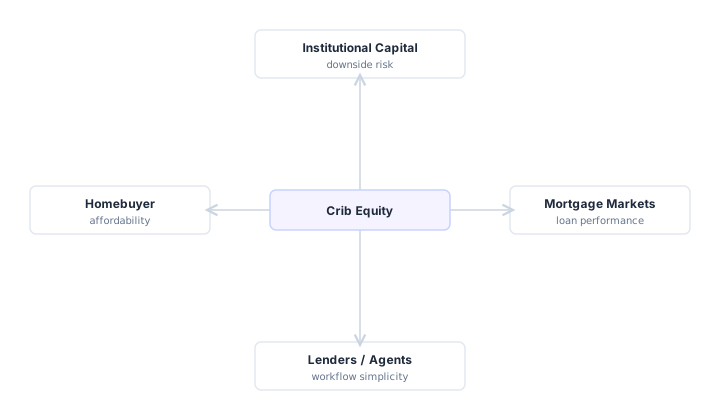
Stakeholder alignment required for shared equity to work
The Insight
The breakthrough came from reframing what we were building. The product did not need a new financial instrument. It needed a structure the mortgage system already understood.
Rather than inventing a novel lien or debt vehicle, we built the product on a tenancy-in-common ownership structure that had existed in real estate for decades. TICs already had extensive legal precedent and regulatory clarity. Courts, title companies, and lenders understood how they worked.
By building on something the system already recognized, we dramatically reduced the institutional friction surrounding the product while modifying the economic relationship between investor and homeowner.
Designing the Product
The product had to satisfy three constraints simultaneously. It had to improve affordability for homebuyers. It had to offer investors an attractive return in an asset class they already wanted exposure to. And it had to work within the existing mortgage and real estate finance system without inviting regulatory scrutiny or creating execution complexity for lenders and agents.
Simplicity was the design principle that made it possible to satisfy all three.
A first mortgage creates leveraged exposure to home price appreciation. A down payment gives the homeowner full participation in the home's value while borrowing the majority of the purchase price. This leverage is the mechanism through which most homeowners build wealth, and the same mechanism institutional capital already seeks exposure to.
We used that shared foundation to structure the product: each party participates in appreciation proportional to their capital contribution. The key design requirement was ensuring the homebuyer's participation in that growth wasn't diluted.
For homebuyers, this created clarity. Both parties participate in appreciation on the same proportional terms. The investor isn't extracting disproportionate value, and the homebuyer isn't subsidizing returns they don't share in. For investors, the structure offered leveraged appreciation in residential real estate, an asset class with deep institutional interest, on terms they could model and underwrite.
We also set a fundamental requirement: the product had to be better than the homebuyer's next best alternative in every realistic scenario. In most cases, that alternative was taking on more debt. Even in downside scenarios where home values decline and homeowner equity absorbs the first loss, the buyer's position is comparable to what it would have been with a larger mortgage, except with a lower monthly payment. Being defensibly better than more debt, even in loss scenarios, meant we could also offer the investor certain protections they needed, because the product was still a better outcome for the consumer.
That same requirement gave us credibility with the third constraint. Lenders, real estate agents, and mortgage underwriters all needed confidence that this was a good product for consumers. The documentation process was designed to resemble something loan officers already understood, like the family gift letter commonly used for down payment assistance. The product was additive to the transaction rather than disruptive to it.
What We Got Wrong First
Our initial fee structure was designed for financial precision. Fees to the homebuyer accrued over time, calculated as a percentage of invested capital per year, combined with a share of future home value. The logic was sound: if a buyer stayed in the home for less time, they paid less. The structure was calibrated to fairly distribute the time cost of money across all parties.
Homebuyers didn't want it.
In user testing, buyers told us the accruing fee felt like a penalty for staying in their home longer. The structure was financially fair but emotionally wrong. It created anxiety rather than clarity. Meanwhile, mortgage originators and real estate agents, who work in a world of fixed fees and predictable closing costs, found the accruing model difficult to explain to clients.
Investors, on the other hand, preferred performance-based fees that accrued over time. Their mental model was ongoing capital deployment, not a one-time transaction.
The fix was to stop trying to optimize a single blended fee structure and instead separate the economics for each party. We moved homebuyers to a simple, fixed fee they could understand at the point of sale. Investor fees remained performance-based and accruing. This made the product simpler for each participant even though it added complexity to the overall structure underneath.
That tradeoff was the right call. Adoption depends on clarity at the point of decision, not elegance in the underlying model.
Distribution
Because the product expanded affordability for their clients, mortgage lenders and real estate agents had strong incentives to introduce it. Early growth came through these partners rather than traditional customer acquisition, creating a B2B2C distribution model with effectively zero customer acquisition cost. Designing the product to support the existing transaction ecosystem turned those participants into distribution rather than friction.
We secured approval from the largest non-agency mortgage securitizer in the country to package shared-equity transactions into standard mortgage-backed securities without volume limitations. This was the validation that the product could scale within the existing capital markets infrastructure.
What I Learned
Two lessons from this work shape how I think about product design.
First, products operating inside complex systems must respect the constraints of those systems. Innovation succeeds not when it replaces existing infrastructure, but when it integrates with it. The most important design decision we made was choosing to build on a structure the mortgage system already understood.
Second, financial optimization and consumer clarity are often in tension, and clarity wins. We built a fee structure that was mathematically fair to all parties, and users rejected it because it felt wrong. The version that drove adoption was simpler, less precise, and far more effective. In consumer finance, the product people trust is the one they can understand immediately.