Work
/ Case study
Turning an Opaque Real Estate Market into a Measurable System
How we built market intelligence and workflow automation to win transactions at Modus
Context
At Modus, a real estate technology company in title insurance, revenue was entirely event-driven. Modus operated in several major real estate markets where thousands of listings moved through the MLS each month. But there were no recurring contracts or predictable usage patterns. Every deal depended on whether a real estate agent chose Modus for their next transaction.
The decision that determined capture happened early, often before a home was even listed for sale. When an agent or transaction coordinator opened a preliminary title report, that decision effectively locked in the title company for the entire transaction. If we received the preliminary title request, we almost always captured the deal. If we didn't, the business went elsewhere.
We had very little visibility into that decision.
The Problem
We observed inconsistent capture across agents. Some worked with us repeatedly. Others would complete one transaction and disappear for months. But silence was ambiguous. Real estate agents don't transact on a predictable schedule. When an agent stopped opening files with us, we couldn't tell whether they had no new transactions or whether they had opened title with a competitor.
Title and escrow markets have no centralized reporting of which company opens a transaction. Like most real estate data, title capture is a trailing metric, typically visible only after a transaction closes, often months after the initial decision was made. We lacked visibility into which agents were actively producing, how frequently they transacted, which title companies were winning those transactions, and what our true market share looked like.
We were operating blind in our own market.
Building Market Visibility
To solve this, we needed to see what was actually happening in the market, not just the transactions we captured.
We built an integration with MLS listing data that allowed us to monitor activity across our markets. Getting access to this data required some startup resourcefulness. MLS data licensing is expensive and designed for brokerages, not title companies. Rather than wait for a formal data agreement, we partnered with a friendly agent who gave us access to their MLS feed. This let us move fast, validate the concept, and build the integration before committing to a costly licensing deal.
The system allowed us to identify new listings and attribute them to specific agents, observe agent production frequency, parse listing comments to detect where preliminary title had been opened, and identify which title company was referenced.
This gave us something we had never had before: visibility into the entire market, not just the transactions we captured. We could now see agent-level production patterns, competitive capture across title companies, geographic market share trends, and opportunity sizing for new markets.
For the first time, we could see who was producing listings, which title companies were winning those transactions, and where the real opportunities for growth were.
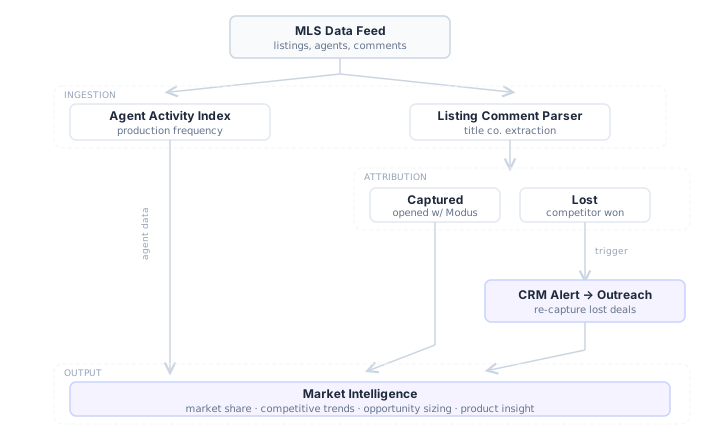
MLS-to-automation system flow
Connecting Market Data to Sales and Product
We connected the MLS intelligence system to our CRM so that when a listing appeared that should have been opened with Modus but wasn't, the sales team could reach out to the agent directly.
These conversations, combined with the listing data, revealed a consistent pattern. Agents repeatedly told our team they hadn't realized their new files weren't being opened with Modus. Because the property was still in the listing phase, we were often able to redirect the transaction back to Modus before the title process progressed further.
The Insight
Lost transactions were rarely the result of dissatisfaction. Agents told us they liked working with Modus and intended to continue.
In many real estate teams, a transaction coordinator manages the operational side of opening title. These coordinators often defaulted to the title company they had historically worked with. The choice wasn't strategic. It was habitual.
This disproportionately affected our most valuable partners. Higher-producing agents were more likely to delegate file-opening to transaction coordinators managing multiple listings. Because coordinators controlled the workflow, their defaults determined which title company received the business, regardless of the agent's preference.
This reframed the problem. The challenge wasn't winning preference. It was becoming the default workflow.
Reducing Friction at the Moment of Action
The traditional process for opening preliminary title looked like this: an agent emailed a property address to a title representative, the email sat in someone's inbox, a title officer manually assembled the report, and the report came back 24 to 48 hours later. Timing depended on staffing, time of day, and queue backlog.
We realized we could remove this delay entirely. We built an automated system that allowed agents to enter an address directly online or forward an email containing the property address to our team. The system generated and returned the preliminary title report near-instantly.
The goal was simple: make opening title with Modus the fastest and easiest option available.
Impact
The MLS integration gave us the first reliable view into agent production activity, competitive title capture, and market-level opportunity across our regions. Internally, this visibility informed product improvements, sales outreach, market expansion decisions, and strategic partnership discussions with real estate organizations.
At the product level, insights from the data directly led to our automated preliminary title experience, which compressed the time to open title from days down to minutes. These systems shifted the company from operating reactively to operating with real market intelligence. Instead of guessing why business was lost, we could observe, investigate, and respond.
What I Learned
Two lessons from this work shape how I approach product problems today.
First, in industries without recurring revenue, silence is not a signal. You need instrumentation to distinguish inactivity from lost business. Without it, you're making strategic decisions on incomplete information.
Second, customer preference competes with workflow defaults. If your product isn't the easiest option at the moment of action, even satisfied customers will choose something else. In complex systems, winning often means becoming the default.